Turning complex risk data intoa tailored decision-making tool
New Opportunities for Compliance Officers Offered by AI
Context
As part of a University Diploma program at Paris-Panthéon-Assas University, my project group and I were tasked with designing an ethics risk map for a fictional company.
The exercise covered multiple categories of critical risks, potentially involving very different business functions, entities and areas of expertise.
The Challenge
Multi-topic risk maps can quickly become difficult to navigate and use. Corruption risks, human rights risks and other critical risk areas do not necessarily involve the same experts, rely on the same assessment criteria or address the needs of the same decision-makers.
The objective was therefore to rethink how the risk map should be structured in order to combine three essential requirements: methodological robustness, clarity of results and the ability to support effective decision-making.
The Solution
Using AI, I designed a custom-built tool covering the entire risk mapping process, including:
- preparing assessment campaigns and creating interview guides;
- conducting and documenting interviews;
- identifying, qualifying and assessing risk scenarios;
- consolidating results and prioritising critical risks;
- defining and monitoring action plans.
The tool therefore goes beyond the visual representation of a risk matrix. It structures the process from end to end and provides different levels of information so that each user can access the insights relevant to their role without being exposed to the full complexity of the framework.
This approach transforms risk mapping from a document often perceived as a static deliverable into a genuine management and decision-making tool. It can be used throughout the entire process, from initial data collection to remediation monitoring, by all relevant stakeholders, including teams beyond the Compliance function.
The Value of AI
The main learning from this project lies less in the automation of a particular task than in the ability to design a tool that is fully aligned with a specific methodological vision.
Off-the-shelf solutions often require teams to adapt their processes to a predefined set of features. AI reverses this logic: the Compliance Officer can first determine how risks should be identified, assessed, presented and managed, and then develop a tool that precisely supports this approach.
AI therefore makes it possible to create, at a limited cost, tailored solutions that would previously have required significant technical and financial investment.
An Optimal User Experience
Risk assessment is often a time-consuming exercise, as users must constantly switch between the risk-mapping tool and the definitions of the different probability and impact levels.
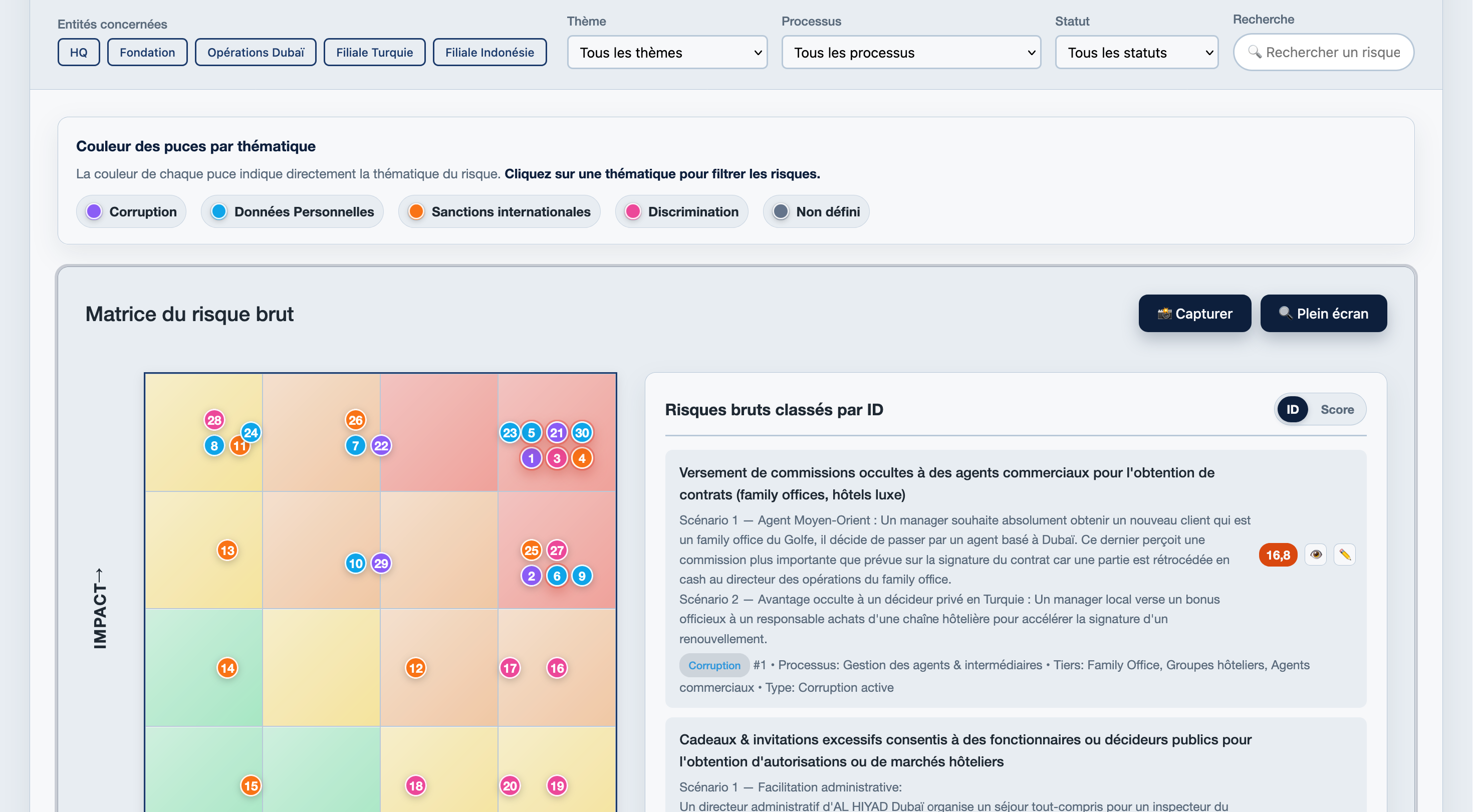
Here, the user experience has been designed to make the process as intuitive as possible. Users can position a risk directly on the matrix while simultaneously viewing the corresponding scale and its dynamic description.
A simple and effective way to align all assessors.
A Tool Designed for Everyone
Although the user experience was initially designed for the Compliance Officer and their team, the tool also addresses the needs of a much broader range of stakeholders:
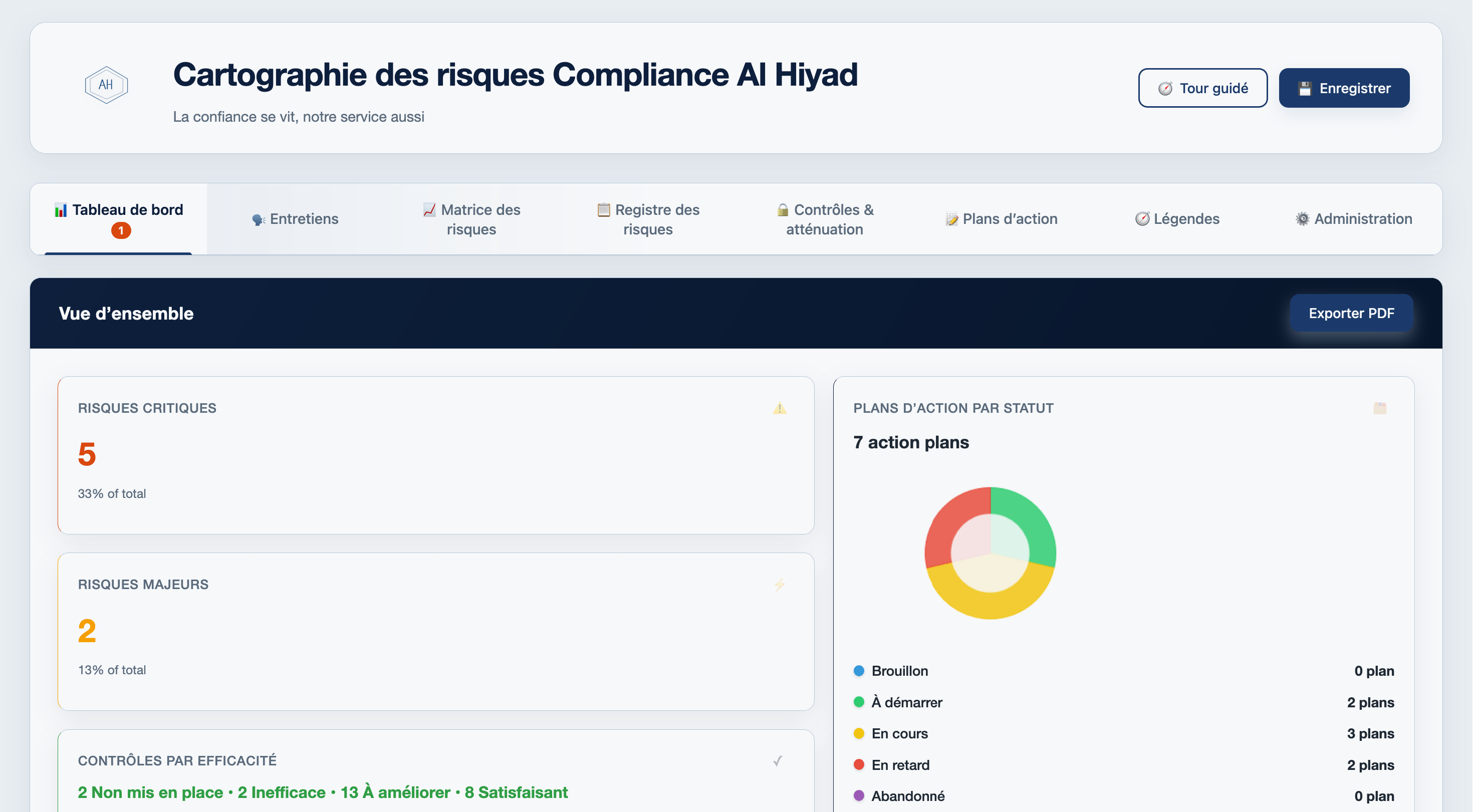
- A high-level dashboard for the Executive Committee, providing an immediate overview of the main risks and potential control weaknesses.
- Business-specific filters enabling each manager to access a view tailored to their needs, whether by topic, process, country or other relevant criteria.
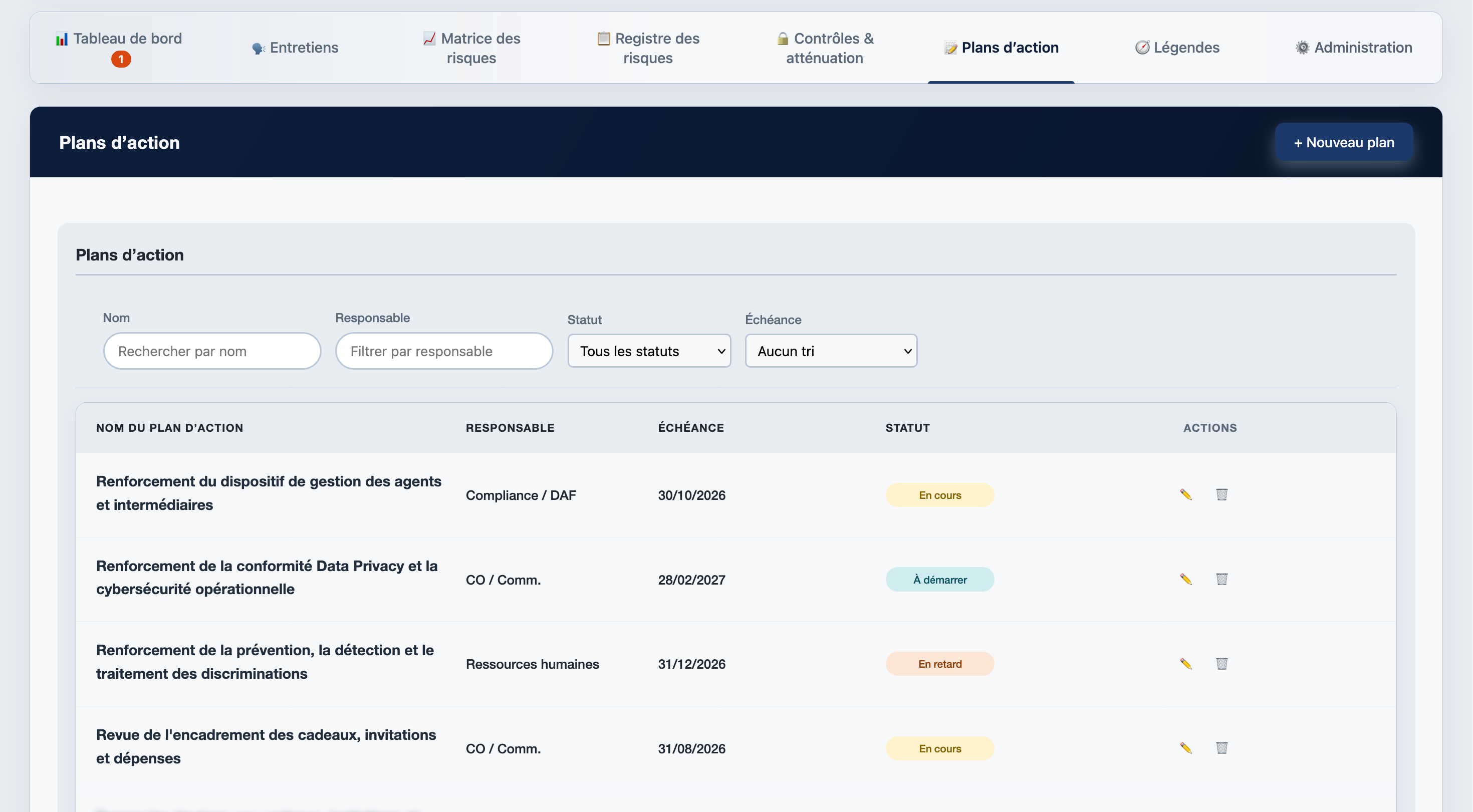
- An action-plan monitoring system with alerts for overdue actions, empowering each action owner to take responsibility for implementation and follow-up.
Fine-Tuned Adaptation to Each Risk Area
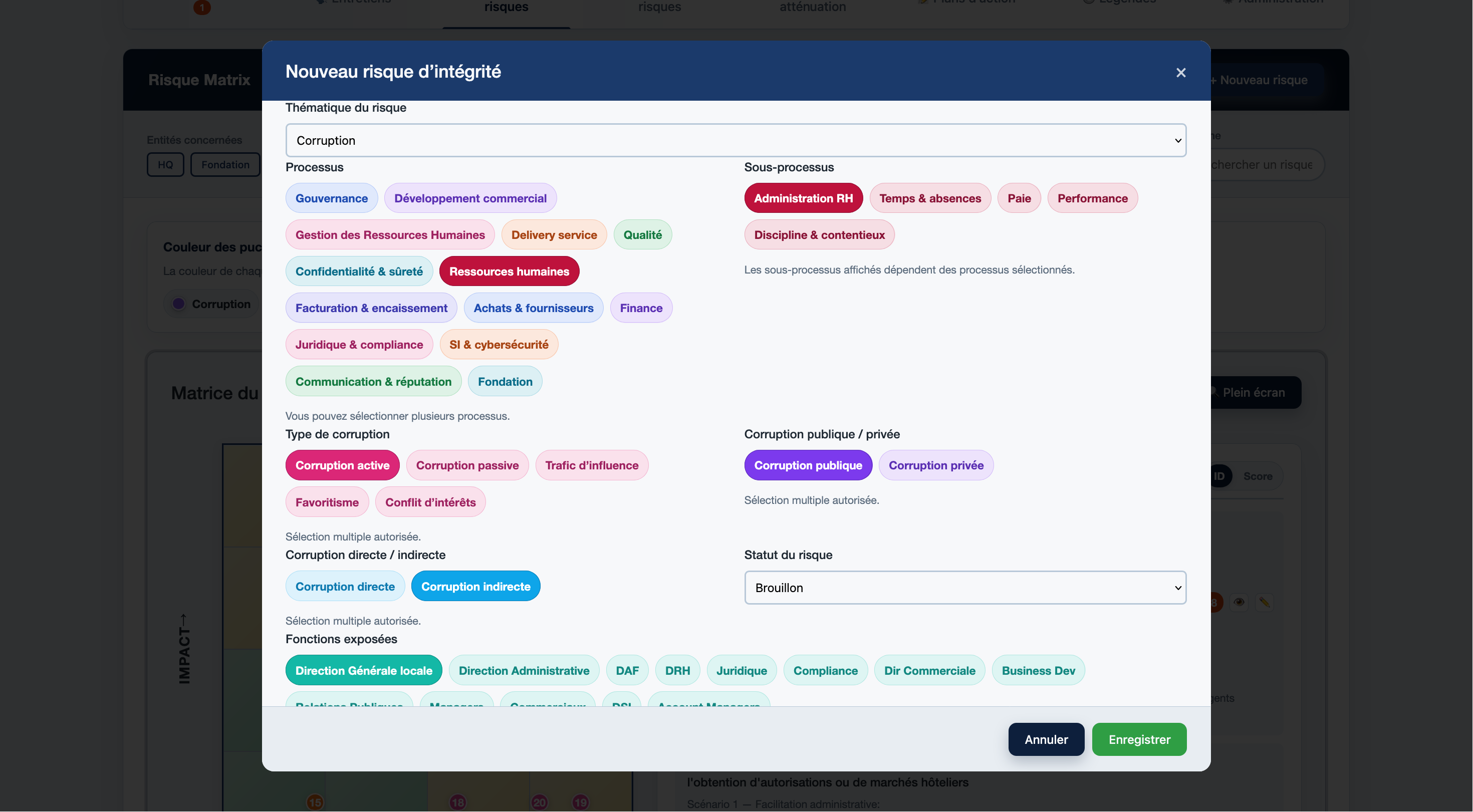
The information requested by the tool automatically adapts to the relevant risk area, ensuring that each assessment remains focused and meaningful. This applies, for example, to aggravating factors.
Operating in a country with a low Corruption Perceptions Index score may be highly relevant when assessing corruption risks, but significantly less relevant when evaluating data privacy risks.
For corruption risks, users can also identify multiple corruption methods or scenarios associated with the same underlying risk.
Complex to implement in Excel. Effortless with this tool.
Complete Consistency Across the Entire Process
Everything is seamlessly connected. When creating a risk, users can directly access the database of existing controls and action plans. There is no need to enter the same information twice: every component is linked.
Interviews are connected to the relevant processes and automatically provide supporting evidence for the risks identified.
This end-to-end consistency strengthens the audit trail and helps demonstrate the robustness and rigor of the methodology to regulatory authorities.